

5.3K
Downloads
312
Episodes
Parenting is the most important job we have for which we almost never have any training. This podcast offers glimpses into effective parenting choices and communication
Episodes

Friday Mar 15, 2019
Friday Mar 15, 2019
With busy families, there is always too much to do and not enough time within which to do it all. Getting and staying organized will reduce the stress of getting everything done and also build family relationships. Three rules come to mind. First, plan upcoming events with at least 3-days' notice. Second, delegate, delegate, and, oh yeah, delegate. As your kids get older, they can help out. You may have to show them and teach them at first, but doing for themselves will lighten your load. Finally, use weekly family meetings to look at how the past week went and to plan events coming up in the next week. Keep a large, dry erase calendar where everybody can post things as they come up. No surprises equals better planning. Lighten your load by staying organized.

Wednesday Mar 13, 2019
Wednesday Mar 13, 2019
When you are able to help your child stay in the moment, you are clearing out the potential emotional baggage that clutters life decisions. Focusing on past situations and issues tends to ramp up depression. Focusing on future situations and potential issues tends to ramp up anxiety. Mindful parenting promotes focusing on both yours and your child's needs and feelings at that moment. It is the best opportunity to successfully sort things out. It can also be a source for teachable moments and will enhance emotional intimacy. Be a mindful parent and help your child stay in the moment.

Monday Mar 11, 2019
Monday Mar 11, 2019
Sometimes, too much is going on. It feels like chaos central at your home. Guess what? You are not alone. Chaos leads to feeling overwhelmed and not in charge. As parents, you want life to be as neat and orderly as possible. When everything seems to be out of control in your home, consider these 3 steps, prepare, instruct, and reward, to regain rule and order.
First, after getting a reading on how over-the-top things are, plan a family meeting to lay it all out for the kids. Prepare to use your active listening during the meeting as the fur flies. Use the meeting to find things that can be scheduled, and then make the schedule. Find things that can be planned for. If morning routine is chaotic, find all the things that can be done the night before, so that mornings are less hectic. For example, pack lunches in the fridge the night before, lay out clothes to wear, secure backpacks. The less cluttered crunch time is, the less chaotic.
Second, make a list of instructions so that the planned tasks will occur accordingly. Give a copy of these instructions to each family member, both for compliance and accountability. Set the following week as the time to implement a "test run" of your plans.
Finally, reward the efforts by all to follow through on the instructions by setting aside a family reward. Of course, things won't go perfectly, so consistency is the name of the game. Chaos central conquered.
Saturday Mar 09, 2019
Saturday Mar 09, 2019
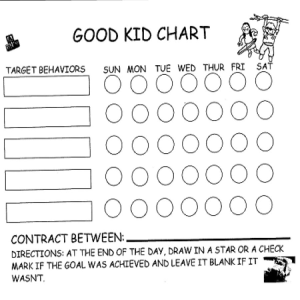
When you notice your child not "getting it," it may be time to help him out. One way is to help him manage his behavior effectively. The Good Kid Chart is a tool I've developed to help parents involve their kids in managing behavior. Putting together your child's Good Kid Chart becomes a joint effort, with ample effort from him in identifying target behaviors and coming up with multiple options for short term reward, longer term reward, and consequences. Children go from fighting with each other to getting along better because they see it as in their best interests to do so, not just because it's in the house rules. When your child needs correction, use The Good Kid Chart to gain his cooperation and it becomes a teachable moment as well.

Thursday Mar 07, 2019
Thursday Mar 07, 2019
The thing about attention is that it has absolute qualities. That is, in terms of getting it, both negative attention and positive attention work. Sadly, negative attention is usually a lot easier to get, and so kids go there a lot, when they need attention. While you do need to confront your child's bad behavior and correct them to get them back in line, wherever possible, try catching them being good. The opportunities may be less than you would like, but the reward and benefit to your child will far outweigh the impact when you have to respond to their negative attention efforts.

Tuesday Mar 05, 2019
Tuesday Mar 05, 2019
To have healthy, emotionally intimate communication with your kids, actually with anybody, you need to attend to both your verbal and nonverbal communication. Verbals and nonverbals are two sides of the coin. When they don't match, the listener is left with, "Wait. What???" What you say and what you do need to convey the same message. If I'm having a conversation with one of my friends and they consistently look away, I will likely stop what I'm saying and ask, "Are you okay? You seem distracted." Their words and actions are not matching. In giving your child your attention, give her all of your attention. Otherwise, she might be left with the conclusion that you don't care about her, or that her words aren't really that important to you.

Sunday Mar 03, 2019
Sunday Mar 03, 2019
A timeout for our children is only meant to be an opportunity for her to cool her jets and think about alternative behavior. Where punishment is warranted, a timeout can morph into a restriction or a natural consequence to correct the bad behavior. If timeouts are given just to get some peace and quiet, the fix will only be temporary. As a rule of thumb, limit your child's timeout to no more than minutes that equal no more than twice her age. So a 10 year old would top out at a 20 minute timeout. Check frequently with your child during their timeout to assure the time is being used wisely and for reflection. Here's where active listening is your best friend. Before ending the timeout, ask her how she could have done things differently and avoided the timeout altogether.

Friday Mar 01, 2019
Friday Mar 01, 2019
Weight can be an issue for kids. Some parents just conclude that kids will grow into their adult bodies, or that he's just being "all boy." However, weight issues can affect both your child's physical involvement in his life, but also his emotional well-being. When you see an emotional fever that indicates your child's size is affecting his body image, use active listening to get to the underlying feelings. When you see his emotional fever subside, ask permission to suggest some specific activities and attitudes he can adopt to bring his body image back in line. Be proactive and involved in your child's healthy choices. Remember, with weight, don't wait.

Wednesday Feb 27, 2019
Wednesday Feb 27, 2019
It's sad but true. We all lie. It's part of the human condition. There are a variety of different types of lying, none of which justify the behavior. When your child lies, you are faced with a critical choice. Do you laugh it off and maybe reinforce this attention-seeking behavior? Do you come down hard on your child and maybe show your power but at the expense of the relationship? Try looking at the lying as a symptom, rather than as an outcome. "Gosh, son. This isn't like you. What else is going on here? Where did that lie come from?" When you see the lie as evidence of an emotional fever, active listening is your go-to response both to get to the bottom of the event and also to turn the lying into a teachable moment. Using natural consequences rather than pure punishment as consequence for lying will also help your child understand the impact of his lying on himself and on others around him. When he is clearly caught in a lie and he denies it, use "the two troubles principle." His behavior buys him one trouble. Does he want to buy two troubles by lying about it?

Monday Feb 25, 2019
Monday Feb 25, 2019
Many families talk about having meetings, but rarely do. If, as the parent, you are a tyrant or a doormat, family meetings will be boring. If you are a benevolent despot, they can be fun and engaging. As benevolent despot, you understand the needs and feelings of all members and make every effort to include everyone in the decision-making process. Family meeting work best when they are routine, relatively short, and the outcome is clear. Where decisions are made, post them for all to see on the family activity calendar in the common area of your home. If you are trying something new, give it a week to breathe and then review how it went. Make sure to include every family member in the discussion. Like a well-oiled machine, family meetings can fine tune and keep families chugging along.